
Intelligent accident-judgment AI
Single threshold → AI hybrid. Distinguishes accidents from everyday vibration. Targets a false-positive rate under 15%.
Autoencoder + Isolation Forest + XGBoost
BCM's autonomous R&D is not just ADAS. It is designed as a five-stage track spanning rider-behavior prediction, accident pre-avoidance, automatic emergency reporting and even operational autonomy. Multimodal data, AI risk scoring and e-Call all run on one stack.
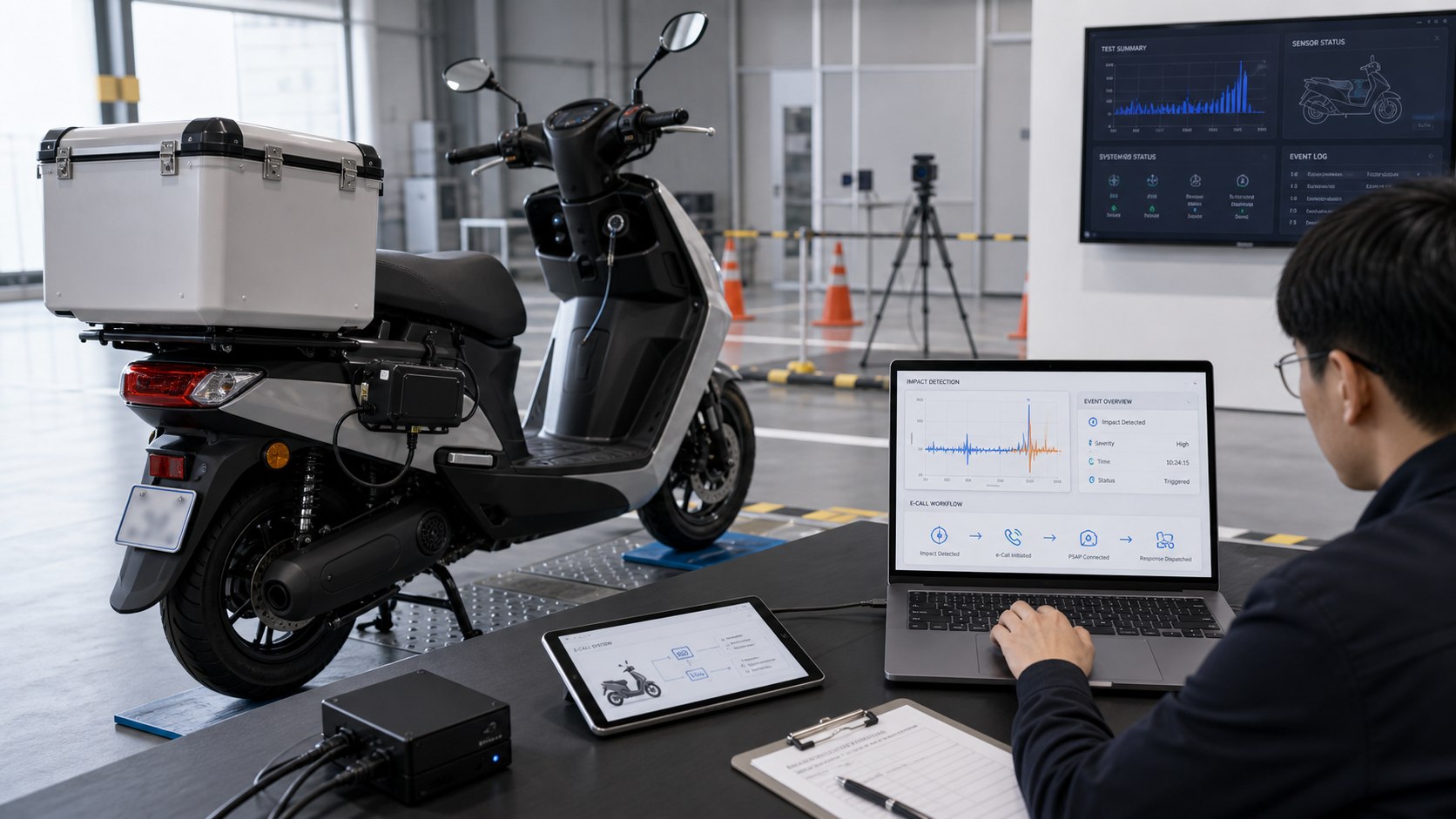
Visualizing IMU impact, safety AI and dispatch routing turns invisible R&D into a legible scene.
Unlike the automotive SAE L0–L5 classification, BCM defines stages by the actual autonomy of two-wheel operations.
Monitoring automation
In operation
Per-second GPS · IMU acceleration · impact collection. ~250 units of real driving data processed via a Google Cloud Dataflow + BigQuery pipeline.
AI accident prediction (e-Call)
Jeonbuk startup-package project (through 2026-12)
An intelligent accident-judgment AI converts single thresholds into an AI hybrid, distinguishes accidents from everyday vibration, and targets a false-positive rate under 15%. Combines Autoencoder + Isolation Forest + XGBoost. On a crash, it auto-reports to 119 with two-way VoIP to the control center.
Real-time multimodal risk scoring
TIPS R&D (Dec '25 – Nov '27)
Fuses four data types — driving, activity, contract, biometric. Detects accident-candidate patterns in advance (currently 74% of 151 accidents pre-detectable on validation data). Rule + Learning hybrid targeting AUC 0.65+ for credit/accident.
Two-wheel ADAS collaboration (planned)
2027~ (joint research with TMAP · Hyundai Motor)
Pilots of KoROAD safe-driving scores on motorcycles; joint research with TMAP and Hyundai Motor on safe-driving-score environments for motorcycles. Linked to usage-based insurance (UBI) riders.
Operational autonomy (long-term vision)
Long-term
FROM 2 TO 4 AND BEYOND — extending the multimodal risk-scoring model proven on two wheels to four-wheel and beyond. Adds local SE-Asia/India environment data toward a global standard operating infrastructure.
Built on the TIPS infrastructure as a Jeonbuk startup-package project. On a crash: automatic 119 reporting, two-way VoIP with the control center, and rider safety protection.
Shows the link between false-positive-reducing accident-judgment AI and the control web.
Single threshold → AI hybrid. Distinguishes accidents from everyday vibration. Targets a false-positive rate under 15%.
Autoencoder + Isolation Forest + XGBoost
Auto-connection on a crash, two-way VoIP with the control center, 119 reporting support. Android-only beta.
Real-time accident-data reception with map-based visualization. Built on Google Cloud Run · MQTT · Redis.
74%
Candidates detectable in advance from data
Precursor patterns derived from 31 intersection/turn/U-turn cases, 45 rear-end cases and 17 pedestrian/bicycle cases, among others.
Joint research on safe-driving-score environments for motorcycles — extending the automotive standard to two wheels.
Safe-driving-score motorcycle pilots — validating whether automotive risky-driving algorithms apply to two wheels.
Drafting accredited-test standards for IP rating, vibration and transient-voltage resistance.
Behavior-based insurance discounts for lower-risk riders — a collaboration model with insurers.